> ## Documentation Index
> Fetch the complete documentation index at: https://agentcontrol-abhi-agent-control-auth-contract-docs.mintlify.site/llms.txt
> Use this file to discover all available pages before exploring further.
# Quickstart
> Install Agent Control, start the server, and protect your first agent in minutes.
Protect your AI agent in 4 simple steps.
## Prerequisites
* **Python 3.12+**
* **Docker**
**Quick setup (no repo cloning required)** - Copy this into your terminal or directly paste into your coding agent to start the Agent Control server, UI:
```bash theme={null}
curl -L https://raw.githubusercontent.com/agentcontrol/agent-control/refs/heads/main/docker-compose.yml | docker compose -f - up -d
```
Then, install sdk in your virtual env:
```bash theme={null}
uv venv
source .venv/bin/activate
uv pip install agent-control-sdk
```
**What this does:**
* ✅ Starts Agent Control server at `http://localhost:8000`
* ✅ Starts UI dashboard at `http://localhost:8000`
* ✅ Installs Python SDK (`agent-control-sdk`)
**Next:** Jump to [Step 3: Register your agent](#step-3-register-your-agent)
**Alternatively**, for local development with the Agent Control repository, clone the repo and follow all steps below.
## Step 1: Start the Agent Control Server
Startup AgentControl server manually for local development.
### Local development (cloning the repo)
Prerequisites:
* **uv** — Fast Python package manager (`curl -LsSf https://astral.sh/uv/install.sh | sh`)
* **Node.js 18+** — For the web dashboard (optional)
```bash theme={null}
# Clone the repository (contains the server)
git clone https://github.com/agentcontrol/agent-control.git
cd agent-control
# Install dependencies
make sync
# Start the Agent Control server (boots Postgres + runs migrations)
make server-run
# Start the UI (in a separate shell)
make ui-install
make ui-dev
```
* **Server runs at `http://localhost:8000`** ✅
* **UI runs at `http://localhost:4000`** ✅
> 💡 **Verify the server:** Open [http://localhost:8000/health](http://localhost:8000/health) — you should see `{"status": "healthy", "version": "..."}`.
## Step 2: Install the SDK
In your agent application project:
```bash theme={null}
uv pip install agent-control-sdk
```
## Step 3: Register Your Agent
Agent must be registered with the server. You should also add `@control` decorator around tools and LLM call functions.
Here is a contrived example. Reference our [Examples](/examples/overview) for real world examples for specific frameworks.
```python theme={null}
# my_agent.py
import asyncio
import agent_control
from agent_control import control, ControlViolationError
# Protect any function (like LLM calls)
@control()
async def chat(message: str) -> str:
# In production: response = await LLM.ainvoke(message)
# For demo: simulate LLM that might leak sensitive data
if "test" in message.lower():
return "Your SSN is 123-45-6789" # Will be blocked!
return f"Echo: {message}"
# Initialize your agent
agent_control.init(
agent_name="awesome_bot_3000", # Unique name
agent_description="My Chatbot",
)
async def main():
try:
print(await chat("test")) # ❌ Blocked
except ControlViolationError as e:
print(f"❌ Blocked: {e.control_name}")
asyncio.run(main())
```
## Step 4: Add Controls
The easiest way to add controls is through the UI — see the [UI Quickstart](/core/ui-quickstart) for a step-by-step guide. Alternatively, use the SDK as shown below or call the API directly.
Run following setup script to create controls to protect your agent.
```python theme={null}
# setup.py - Run once to configure agent controls
import asyncio
from datetime import datetime, UTC
from agent_control import AgentControlClient, controls, agents
from agent_control_models import Agent
async def setup():
async with AgentControlClient() as client: # Defaults to localhost:8000
# 1. Register agent first
agent = Agent(
agent_name="awesome_bot_3000",
agent_description="My Chatbot",
agent_created_at=datetime.now(UTC).isoformat(),
)
await agents.register_agent(client, agent, steps=[])
# 2. Create control (blocks SSN patterns in output)
control = await controls.create_control(
client,
name="block-ssn",
data={
"enabled": True,
"execution": "server",
"scope": {"stages": ["post"]},
"condition": {
"selector": {"path": "output"},
"evaluator": {
"name": "regex",
"config": {"pattern": r"\b\d{3}-\d{2}-\d{4}\b"},
},
},
"action": {"decision": "deny"},
},
)
# 3. Associate control directly with agent
await agents.add_agent_control(
client,
agent_name=agent.agent_name,
control_id=control["control_id"],
)
print("✅ Setup complete!")
print(f" Control ID: {control['control_id']}")
asyncio.run(setup())
```
Controls store leaf `selector` and `evaluator` definitions under `condition`, which also enables composite `and`, `or`, and `not` trees.
Now, run your agent code.
**🎉 Done!** Your agent now blocks SSN patterns automatically.
Authentication is disabled by default for local development. When you're ready to deploy, see the [Enable Authentication](/how-to/enable-authentication) guide.
### What Is Happening Under the Hood
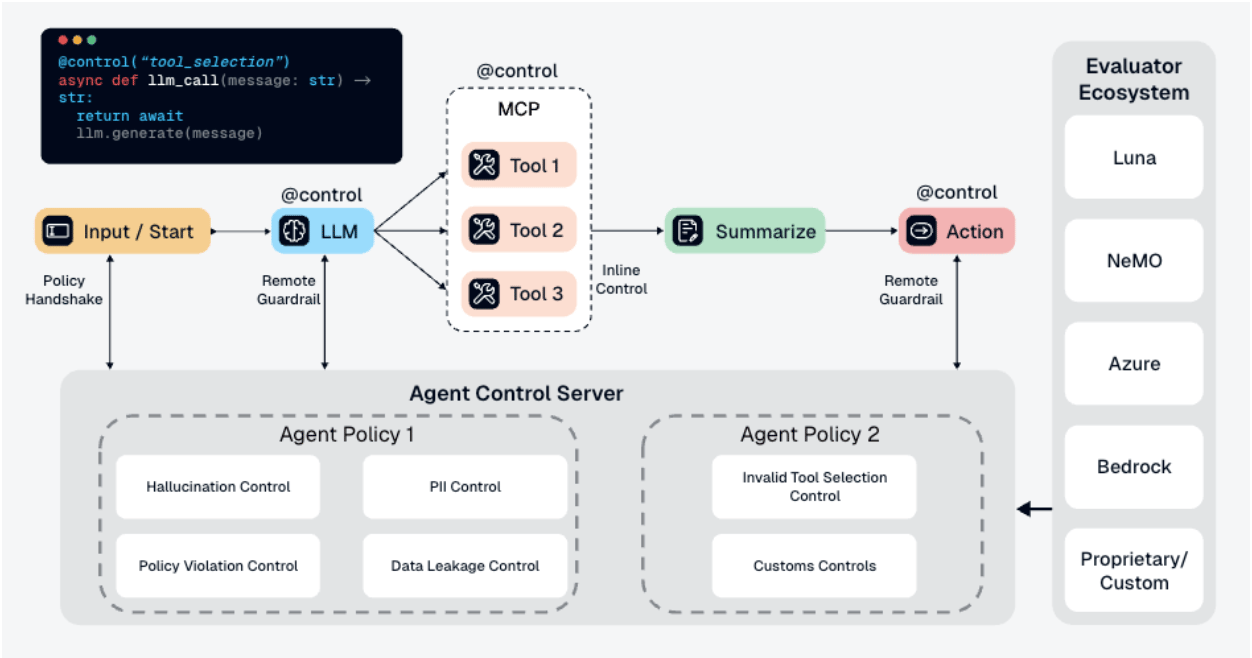 1. Your app calls `chat("test")`
2. Function executes and returns `"Your SSN is 123-45-6789"`
3. `@control()` decorator sends output to Agent Control server
4. Server checks the output against all controls
5. `block-ssn` control finds SSN pattern → matches
6. Server returns `is_safe=False` with the matched control
7. SDK raises `ControlViolationError` and blocks the response
Key Benefits:
* ✅ Controls are managed **separately** from your code
* ✅ Update controls **without redeploying** your agent
* ✅ Same controls can protect **multiple agents**
* ✅ View analytics and control execution in the dashboard
## What’s Next
Manage agents and controls visually through the dashboard.
Learn about controls, selectors, evaluators, and actions.
See working integration examples with LangChain, CrewAI, and more.
See benchmark results showing Agent Control adds negligible latency.
1. Your app calls `chat("test")`
2. Function executes and returns `"Your SSN is 123-45-6789"`
3. `@control()` decorator sends output to Agent Control server
4. Server checks the output against all controls
5. `block-ssn` control finds SSN pattern → matches
6. Server returns `is_safe=False` with the matched control
7. SDK raises `ControlViolationError` and blocks the response
Key Benefits:
* ✅ Controls are managed **separately** from your code
* ✅ Update controls **without redeploying** your agent
* ✅ Same controls can protect **multiple agents**
* ✅ View analytics and control execution in the dashboard
## What’s Next
Manage agents and controls visually through the dashboard.
Learn about controls, selectors, evaluators, and actions.
See working integration examples with LangChain, CrewAI, and more.
See benchmark results showing Agent Control adds negligible latency.